5.26.2014

How Do Evaporative Air Coolers Work?

History 
Circulating air over or through water soaked materials is the basic concept behind evaporative air coolers. Centuries ago, in the Middle East, buildings were designed with wind shafts. These were located on the roof, catching the wind, which would then pass through a reservoir of water. The wind, cooled by water, was then directed into the house to cool the interior.
This concept continued to be used, taking on many forms. In the 1920s, screened porches were commonly used as sleeping porches, particularly in the southwest desert of the United States. Sheets soaked in water were hung inside the screens and fans would pull the night air in through the wet sheets, resulting in a cooler ambient temperature.
Mechanized
The concept of air cooled by water became mechanized in the 20th century, and the evaporative cooler, as it was termed, became the subject of numerous patents. Elements used in these coolers included wood wool pads, a reservoir with a float pump to maintain levels, a pump and a powerful fan.
The fan draws in the warm air from the outside. The air is pulled through the pads, which are typically made of cedar shavings or plant cellulose. The pads are wet; the water pump continually drenches them with water. The water from the pads evaporates into the trapped air, which in turn lowers the temperature of the air. It is then blown into the interior of the building through the ductwork.
Effectiveness
Evaporative air cooler (desert cooler or swamp cooler) work best if the interior of the building is not well sealed. Because the cooled air is being blown into the home, a window or door left slightly open creates a pressure front, resulting in a more forcible circulation of the cooled air. The "faster" the air moves, the cooler if feels against the skin. Evaporative air coolers are more effective in regions with high temperatures but low levels of humidity, such as the Middle East and the southwestern United States. Evaporative air coolers are essentially pushing wet air into the building, creating higher levels of humidity. But if the humidity is already high, and the air is already "wet," the evaporative process is slowed. The air blown into the building isn't as cool; it increases the already high levels of humidity.If the outside temperature is 100 degrees, for example, with a relative humidity of 10%, an evaporative air cooler would lower the inside temperature to 73 degrees. If the humidity were 50%, the cooler would only lower the temperature to 88 degrees.
Green Alternative
Air conditioners use refrigerants such as chlorofluorocarbons and hydro-chlorofluorocarbons to cool the air that is then blown into the interiors of buildings. These refrigerants are considered by some to be harmful to the ozone layer.
Evaporative air coolers use no refrigerants. The basic components are air, water, and pads made from wood or cellulose. The only chemicals used are those used in the manufacture of the pads; they are impregnated with a chemical compound to protect them against rot.
The cost of operating an evaporative air cooler can be up to two-thirds less than operating an air conditioner.The basic operative principle, though, prevents this device from being the dominant cooling system in the United States and Europe. It is dependent on low humidity levels for effectiveness.

7.26.2012

Does a Window Have to Be Open When Running an Evaporative Air Cooler?


    Evaporative air cooler can lower room temperatures as much as 30 degrees. Forcing fresh air over damp fabric to cool a space is one of the oldest methods of air conditioning. It is easy and effective in dry climates. Even though the principle is simple, you may have questions about how evaporative cooling systems should be run.
     Fundamentals
  • Air conditioning cools and recalculates air in a room or in an entire building. It is essential to keep the windows closed so the cooled air does not escape. However, evaporative air  cooler work differently. They pull fresh air into a room, and as it passes over damp pads, it cools the room. As the cool air fills the room, the hotter air is forced out. With really efficient evaporative cooling, a total air change in the space can take place every two minutes.
Evaporative air cooler
Varieties
  • Evaporative air cooler systems can cool an entire dwelling or a single room. The room units are often placed in windows, not unlike window air conditioning units. In larger systems, duct work and fans together move air throughout the space to allow cool air to enter each room. A simple system uses one duct and fan setup to let in air and blow it into the house.
      Balance
  • The purpose of opening a window is to let the warm air escape as the cooler air is circulated by the evaporative cooler's fan. Open the door and a window inside any room you wish to cool so the air can move through. To get a balance of cool air throughout the space, leave both a door and window open in the room to allow air to circulate.
Adjustment
  • How much you open a window can determine the evaporative cooler efficacy. Open the window just enough so the door closes very slowly. This means the pressure is balanced, and the hot air is moved through the window as exhaust. If the door slams, the window is not open wide enough. However, don't open the window too far. If the door does not move, the window is too widely open. When the door closes completely, open it and start the process over.

5.14.2012

Application and examples of evaporative air cooler

  With the deepening of energy-saving and emission reduction in the globe, energy-saving and emission reduction has deepened into all the aspects of people’s life. Especially the air conditioning refrigeration area is the focus of energy-saving and emission reduction. Evaporative air cooler, which develops fast in recent years, is the outcome of energy-saving and emission reduction time.
   Evaporative air cooler has a history of 60 years in USA. Australia begin to develop evaporative air cooler from 1970s, but it grows fast and best. In the late 1990s, evaporative air cooler was introduced to China, and develops well. Now a great number of evaporative air cooler are sold to abroad every year.
Many areas try to use evaporative air cooler. Especially in hot and dry areas, big difference between dry and wet bulb temperature can be up to 9~15℃ or even worse. In such cases, evaporative air cooler is the best choice for its energy saving and better cooling efficiency.
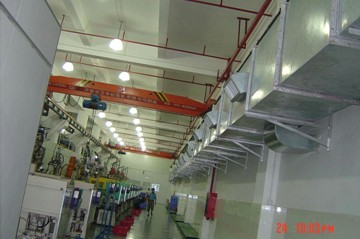
   In southern China, evaporative air cooler is suitable for factory and production areas with high temperature heat source, including factory of textile, garment, dyeing and tannery, industry of hosiery, chemical, electronic and packing, plant of plastic processing, printing , electro mechanic, hardware, metallurgy and food. In northern China, evaporative air cooler can be used in densely populated public places, such as supermarket, shopping mall, farmer’s market, villa, gym, restaurant, hotpot restaurant, hospital outpatient hall, bus waiting room, song and dance hall, bar, game center, school and auditorium.
   Evaporative air cooler can be used in other places as below.
1. Air-polluted, bad smelling and heavy dust places.
2. Areas that have been installed with air-conditioning but with little fresh air or lack of oxygen gas.
3. Agricultural scientific research base,  training center and  greenhouse
4. Position cooling. In high temperature plants, such as steel works and foundry, workers work in high temperature. Evaporative air cooler can bring fresh and cool air to them by position cooling.
5. Stockyards. Evaporative air cooler helps to avoid plague, improve living rate and reduce disease.
   Below are some installation examples.

HOGGERY

DEPARTMENT STORE


DATA CENTER


INJECTION MOLDING FACTORY


TEXTILE PLANT


GARMENT FACTORY

RESTANRANT

OUTDOOR

AIRPORT

COFFEE SHOP


ELECTRONIC FACTORY


PACKING HOUSE


4.02.2012

China Refrigeration 2012

China Refrigeration 2012                                                                                         
Date:11-13th April.2012                                                                                               
Place:Beijing New International Exhibition Center                                                                
Booth No:E2B51
Welcome to Aolan

111th Canton Fair 2011

The 110th China Export Commodities Fair (Canton Fair)
Date: 15th-19th April,2012
Place: China Export and Import Exhibition Centre
Booth NO: 1.2D39,Exhibition Area for Home Appliance
Welcome to Aolan