5.14.2012

Application and examples of evaporative air cooler

  With the deepening of energy-saving and emission reduction in the globe, energy-saving and emission reduction has deepened into all the aspects of people’s life. Especially the air conditioning refrigeration area is the focus of energy-saving and emission reduction. Evaporative air cooler, which develops fast in recent years, is the outcome of energy-saving and emission reduction time.
   Evaporative air cooler has a history of 60 years in USA. Australia begin to develop evaporative air cooler from 1970s, but it grows fast and best. In the late 1990s, evaporative air cooler was introduced to China, and develops well. Now a great number of evaporative air cooler are sold to abroad every year.
Many areas try to use evaporative air cooler. Especially in hot and dry areas, big difference between dry and wet bulb temperature can be up to 9~15℃ or even worse. In such cases, evaporative air cooler is the best choice for its energy saving and better cooling efficiency.
   In southern China, evaporative air cooler is suitable for factory and production areas with high temperature heat source, including factory of textile, garment, dyeing and tannery, industry of hosiery, chemical, electronic and packing, plant of plastic processing, printing , electro mechanic, hardware, metallurgy and food. In northern China, evaporative air cooler can be used in densely populated public places, such as supermarket, shopping mall, farmer’s market, villa, gym, restaurant, hotpot restaurant, hospital outpatient hall, bus waiting room, song and dance hall, bar, game center, school and auditorium.
   Evaporative air cooler can be used in other places as below.
1. Air-polluted, bad smelling and heavy dust places.
2. Areas that have been installed with air-conditioning but with little fresh air or lack of oxygen gas.
3. Agricultural scientific research base,  training center and  greenhouse
4. Position cooling. In high temperature plants, such as steel works and foundry, workers work in high temperature. Evaporative air cooler can bring fresh and cool air to them by position cooling.
5. Stockyards. Evaporative air cooler helps to avoid plague, improve living rate and reduce disease.
   Below are some installation examples.

HOGGERY

DEPARTMENT STORE


DATA CENTER


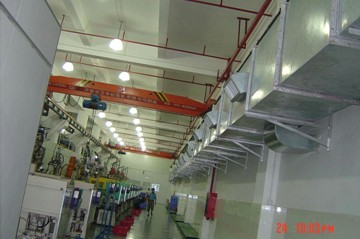
INJECTION MOLDING FACTORY


TEXTILE PLANT


GARMENT FACTORY

RESTANRANT

OUTDOOR

AIRPORT

COFFEE SHOP


ELECTRONIC FACTORY


PACKING HOUSE


4.02.2012

China Refrigeration 2012

China Refrigeration 2012                                                                                         
Date:11-13th April.2012                                                                                               
Place:Beijing New International Exhibition Center                                                                
Booth No:E2B51
Welcome to Aolan

111th Canton Fair 2011

The 110th China Export Commodities Fair (Canton Fair)
Date: 15th-19th April,2012
Place: China Export and Import Exhibition Centre
Booth NO: 1.2D39,Exhibition Area for Home Appliance
Welcome to Aolan

3.22.2012

Evaporative air cooler installation –top discharge and side discharge

Keywords: Evaporative air cooler, installation, top discharge, side discharge, wall installation, stander of evaporative air cooler

1 Instruction:
AOLAN Industrial evaporative air cooler has top discharge, down discharge and side discharge optional. We design these, mainly because in the actual installation process, you will encounter different installation requirements. Sometime you will need to install the cooler with stander used as one portable cooler.
2 Wall installations:
A Top discharge:

B Side discharge:

Tips:

3 Install with one stander as portable cooler:
A top discharge air cooler with elbow duct and stander:

B side discharge air cooler with deep tank and portable stander:


An evaporative cooler


 An evaporative cooler (also swamp cooler, desert cooler, and wet air cooler) is a device that cools air through the evaporation of water. Evaporative cooling differs from typical air conditioning systems which use vaporcompression or absorption refrigeration cycles. Evaporative cooling works by employing water's large enthalpy of vaporization. The temperature of dry air can be dropped significantly through the phase transition of liquid water to water vapor, which requires much less energy than refrigeration. In extremely dry climates, it also has the added benefit of conditioning the air with more moisture for the comfort of occupants. Unlike refrigeration, it requires a water source, and must continually consume water to operate.
 In the United States, the use of the term swamp cooler may be due to the odor of algae produced by early units.[1] Air washers and wet cooling towers use the same principles as evaporative coolers but are optimized for purposes other than cooling the air inside a building. For example, an evaporative cooler may be designed to cool coils of a large air conditioning system to increase its efficiency.
 Evaporative cooling is especially well suited for climates where the air is hot and humidity is low. In the United States, the western/mountain states are good locations, with evaporative coolers prevalent in cities like Denver, Salt Lake City, Albuquerque, El Paso, Tucson, and Fresno where sufficient water is available. Evaporative air conditioning is also popular and wellsuited to the southern (temperate) part of Australia. In dry, arid climates, the installation and operating cost of an evaporative cooler can be much lower than that of refrigerative air conditioning, often by 80% or so. However, evaporative cooling and vaporcompression air conditioning are sometimes used in combination to yield optimal cooling results. Some evaporative coolers may also serve as humidifiers in the heating season.
 In locations with moderate humidity there are many cost-effective uses for evaporative cooling, in addition to their widespread use in dry climates. For example, industrial plants, commercial kitchens, laundries, dry cleaners, greenhouses, spot cooling (loading docks, warehouses, factories, construction sites, athletic events, workshops, garages, and kennels) and confinement farming (poultry ranches, hog, and dairy) often employ evaporative cooling. In highly humid climates, evaporative cooling may have little thermal comfort benefit beyond the increased ventilation and air movement it provides.